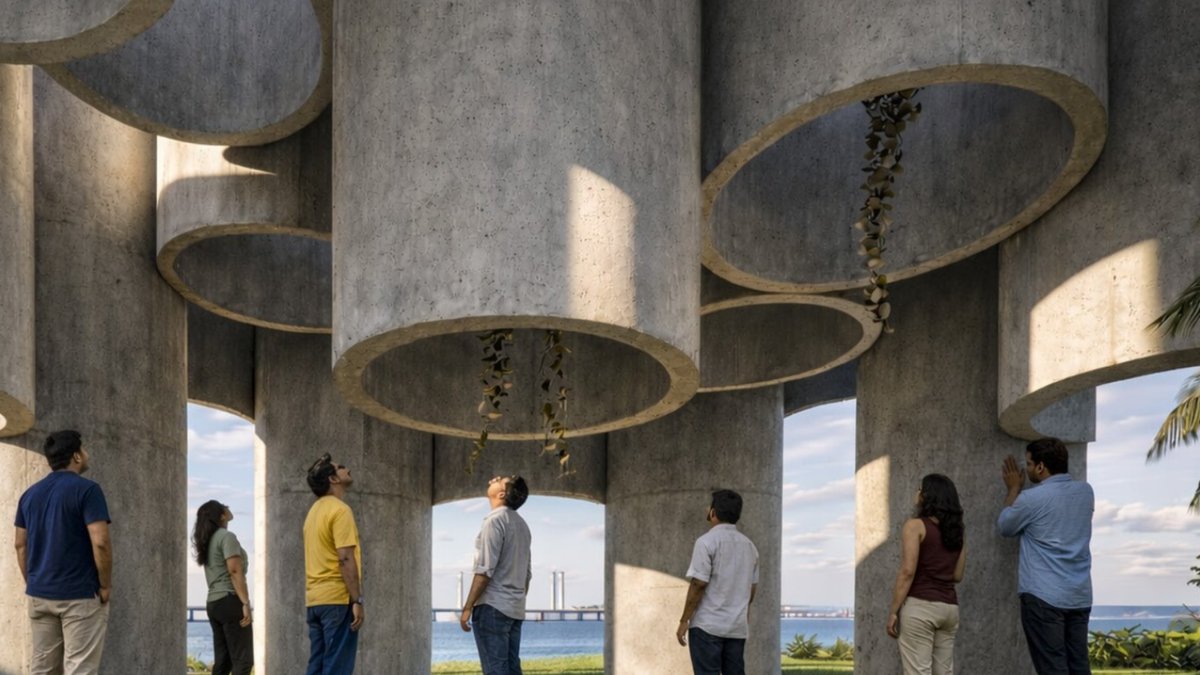
Re:Concrete transforms discarded precast concrete drainage pipes into a modular public pavilion on the coast of Mumbai. The project, which earned an Honorable Mention at the Buildner International Concrete Pavilion Competition, repurposes surplus or rejected pipes that were originally intended for underground water management systems. The design preserves the tubular geometry of the elements, using them as walls, thresholds, seats, and hanging volumes instead of breaking them down into aggregate.
Modular Construction from Existing Materials
The structure relies on standard pipe sections with a diameter of approximately 2.1 meters and a length of 2.5 meters. Designers select surplus, defective, or dismantled pipes that remain structurally sound, then cut or rotate the pieces to stack them at different levels. This method allows the pavilion to adapt to the number of pipes available, enabling a smaller or larger construct depending on the material state and quantity.
Curved sections at ground level form walls, doorways, and portals with concave surfaces that serve as seating. Other curved sections are raised to create suspended cylindrical shapes. These raised sections generate circular holes that let daylight into the pavilion. The arrangement produces a mixture of enclosed and open areas, while narrow slots between sections direct the eye toward the ocean.
Read Also: Chennai Developers Explore Colombo’s Port City Opportunities
The construction method uses a dry assembly and reversible system. It does not intend to become part of a fixed concrete construct. This approach gives flexibility to assemble and disassemble the pavilion and reuse individual pipe pieces elsewhere. The design process accounts for the availability of salvaged material rather than standardizing beforehand.
Exposed Materiality in an Urban Context
The design incorporates the intrinsic characteristics of the recycled material directly into its structure. The dimensions, width, seams, visible surfaces, and weathering traces on the concrete pipes are evident. This industrial aesthetic creates a direct connection between the pavilion and the infrastructure it originated from.
Extending the Life of Concrete Components
This concept shifts the conversation of concrete recycling beyond breaking down aggregates or forming new mixes. By retaining the original pieces, Re:Concrete maintains the pipe’s form and the labor invested in them. The initiative raises the question of whether concrete structures can be given a second life without transforming them into another form.