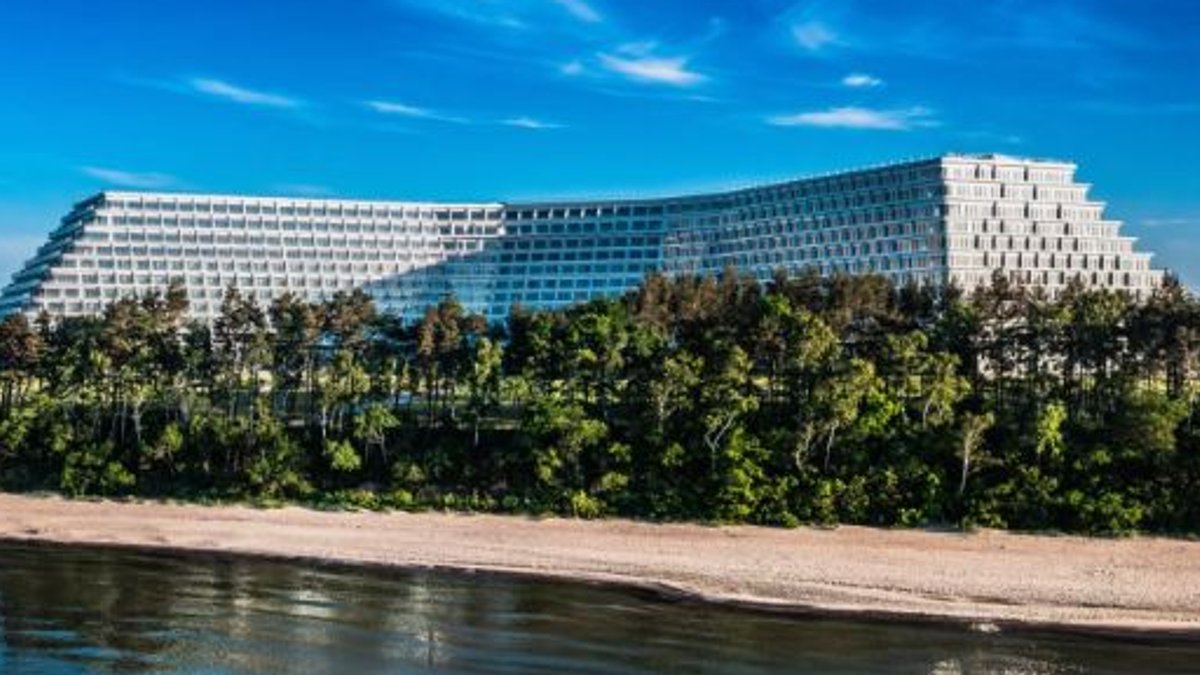
Poland’s hotel market has shifted its focus from quantity to quality, with investors now prioritizing the standard of hotels over the number of new openings. Katarzyna Tencza, Transaction Director at Walter Herz, notes that the Polish hotel market is maturing, and competitive advantage is now driven more by quality than by quantity.
Demand for hotel rooms in Poland continues to climb, with operating performance also improving. The country now has over 2,600 hotels, with almost 50 new hotels added in 2025 alone, and total bed capacity increasing by 4.3% year-on-year to 334,700.
International Brands Expand Presence
International brands are increasing their presence in Poland, with 263 hotels across the country now carrying the flag of 58 brands from 17 global chains. One notable example is the Hotel Gołębiewski in Pobierowo, which opened this year with around 1,200 rooms, making it one of the largest single hotel investments Poland has ever seen.
In Warsaw, the former Gromada Lotnisko Hotel has been reborn as the 390-room Campanile PRIME and Première Classe Warsaw Airport complex. This trend towards larger, more ambitious projects is expected to continue, with several high-profile developments in the pipeline, including Canopy by Hilton, AC by Marriott Port Praski, and JW Marriott-branded redevelopment of the Regent Hotel.
Regional Variations
Warsaw remains the region’s undisputed heavyweight, with over 19,200 rooms and 5.5% supply growth in 2025. Other cities are also attracting attention from investors. Cracow, for example, has seen occupancy overtake Warsaw’s for the first time since 2019, and a thin 2026 supply pipeline is expected to keep performance climbing further.
Related: Henley completes sale of Galeria Pestka in Poznań
Gdańsk’s Tri-City posted the country’s highest average hotel rates in 2025, with several new hotels set to add over 1,000 rooms in the years ahead. In contrast, Wrocław’s rapid growth in room count has been accompanied by declining occupancy and RevPAR, highlighting the risks of oversupply in the market.
Poland’s hotel investment market saw just €135m in transactions across 12 deals in 2025. This limited availability of investment-grade hotel assets is driving investors to consider alternative routes into the market, such as forward funding, joint ventures, and development partnerships.
Renovation and Repositioning
Renovation is emerging as a key trend in the Polish hotel market, with investors repositioning well-located assets to meet current market standards. Examples include the former Hotel Tychy & Tychy Prime relaunching as B&B Hotel Tychy, and the Cracow-bound Royal Hotel returning as Le Méridien. Katarzyna Tencza notes that repositioning has become just as important a source of new hotel supply as new developments.
The sector’s next chapter will be written by recovering business travel, the rise of bleisure trips, and Poland’s growing pull as a destination. As Katarzyna Tencza adds, the recovery of business travel and the expansion of bleisure trips will be key factors supporting the sector in 2026.
Poland is well-placed to capitalize on the growing demand for travel and tourism, with its rich history, cultural attractions, and natural beauty. As the country’s hotel market continues to evolve, it is likely that there will be a greater emphasis on sustainability, technology, and innovation, as well as a growing recognition of the importance of creating memorable and authentic experiences for guests, much like successful agents find the secret to success.