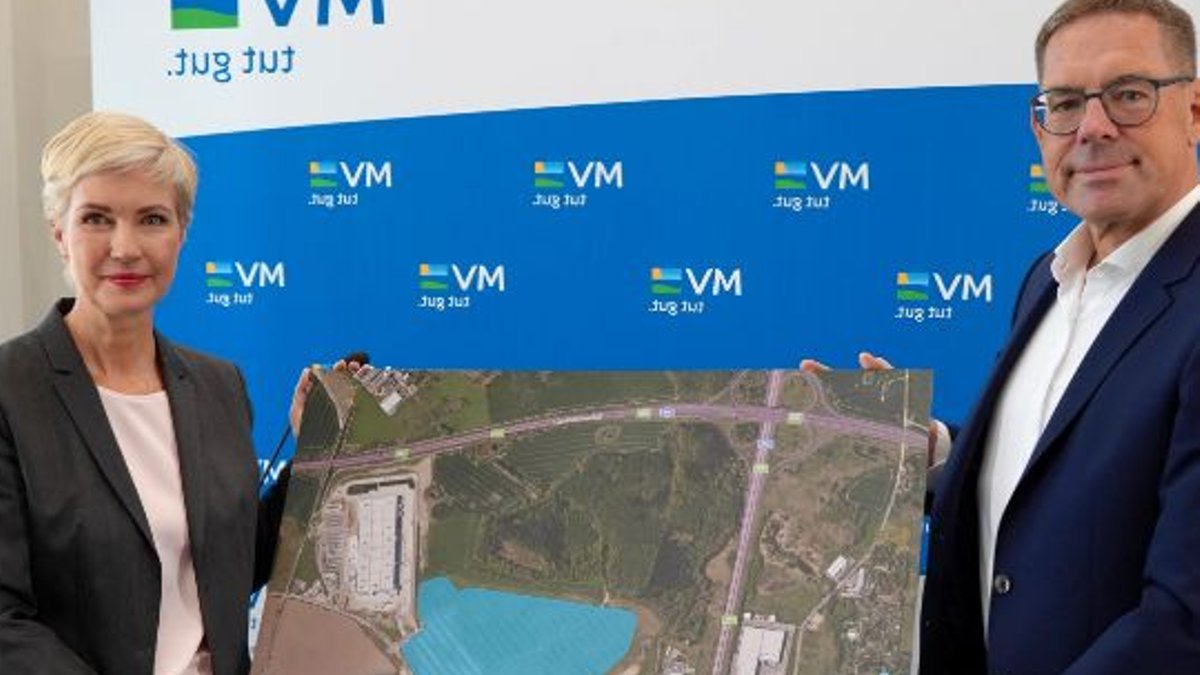
Schwarz Group, the retail and IT conglomerate behind Lidl and Kaufland, has announced plans to invest up to €5.6bn by 2033 in a new data centre in Mecklenburg-Vorpommern, Germany.
This project is expected to have a capacity of 240 megawatts by 2033.
The investment is seen as a significant boost to the local economy, with the potential to create new jobs and stimulate growth in the region.
According to the filing, the facility will be connected to the 380-kilovolt extra-high-voltage grid, which will help reduce transmission losses and grid fees.
This technical advantage will create a realistic pathway to a full 1 gigawatt grid connection by 2045, making it an attractive option for investors and developers.
The site selection for the data centre was made with sustainability in mind, with the facility expected to be powered by onshore and offshore wind power from Northern Germany.
The region’s climate also supports efficient free cooling using ambient air, reducing the need for energy-intensive cooling systems.
A letter of intent has been signed with Rostock’s public utility to channel the data centre’s waste heat into municipal district heating planning.
Related: Søren Rodian Olsen joins Newmark Polska, launches advisory
This agreement echoes a similar district heating agreement Schwarz Group recently signed for its data centre project in Lübbenau, Brandenburg.
The partnership between Schwarz Group and the state government of Mecklenburg-Vorpommern extends beyond infrastructure into public administration.
By the end of 2026, the state government plans to roll out digital building permits on the sovereign cloud platform STACKIT and introduce OpenDesk, starting with secure, fully managed teacher workstations in schools.
These developments were made jointly with Schwarz Digits, the IT and digital division of Schwarz Group, and are intended to serve as a model for digital administration across Germany.
Mecklenburg-Vorpommern becomes a hub for digital infrastructure.
The Dummerstorf project is still in its early stages, with technical specifications for cloud and AI microchip configurations still to be finalized and subject to standard approvals.
Despite this, the scale of ambition is clear, with a data centre investment measured in billions of euros tied directly to national digital sovereignty policy.
This marks one of the clearest signals yet that Germany’s states are competing hard to become the physical backbone of Europe’s AI and cloud economy.